Tuesday, August 10, 2010

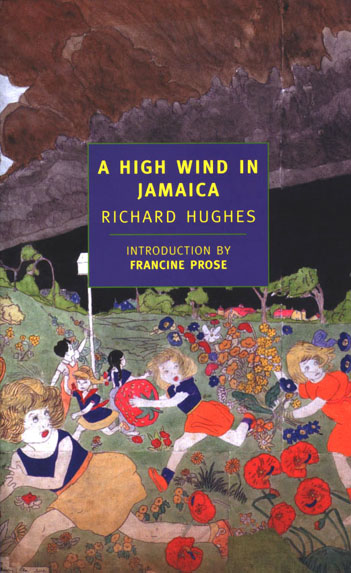
A Highwind in Jamaica

A few months ago, I devoured A High Wind in Jamaica by Richard Hughes. One of the best books you probably have never heard of. For some reason this book has sailed beneath the radar of most high school and college curricula for decades. To be sure, it is a highly regarded classic, and even made it onto the Modern Library's top 100 Novels of the 20th Century at 71.


What's so compelling about this novel? As is my want with book reviews, I'm not going to attempt a plot summary (besides: Amazon got their B.S. in writing summaries). I'm not going to dwell on its wicked and unsparing use of clever irony, that it was visionary for its time, the subject matter, the ineffible prose that Hughes hews to his intent. For a study in great writing alone, each of the traits makes it worthwhile. Instead, I want to share why I personally think this book is so deserving the title masterpiece. Perhaps it's fitting with High Wind's opening, so teeming with biodiversity, that my admiration lies in the archives of zoological curiosities.

I once read about an uncanny documented phenomena in the animal kingdom: predator clans will on rare occasion adopt and take care of a member of their prey. No kidding, scientists have seen prey striding in front of their apathetic and unconcerned lethal companions with innocent bravado. They pay it no mind.

The canonical case cited concerned a rattle snake den and a field mouse. It is not known how a field mouse managed to insert itself amongst the population of snakes, but it had. Scientists documented it running about these deadly serpents in broad daylight, and they responded with which would be most accurately anthropomorphized as "bored affection".

Then one day a foreign snake crossed into their territory. It saw the field mouse, and instantaneously lunged critically wounding it. No one wants to pass up a free lunch. Almost immediately the rattlers which had formerly looked after this mouse pounced, tearing it to shreds.

The Bas-Thorton children are tossed from their Jamaican kingdom and find themselves captives of pirates after a series of random natural disasters and the maladroit negotiations of a bungling sea captain. They succeed in befriending the pirates and absorb them in their games and fancies. You can't call it Stockholm Syndrome because the children are hardly cognizent of the greater events governing the radical direction their lives have taken.

The lines blur from the outset as to who are the snakes and who are the mice, but the succinct conclusion brings it to chilling focus. The fact that we instinctively and painfully relate to each of the twists and characters makes the conclusion all the more unnerving.

It's a relatively quick read, and well worth it.

Saturday, July 17, 2010

Lag BaOmer videos

Okay so this happened a couple months ago and I took some videos but never got around to posting them. All of these videos were taken on the 22rd night of the counting of the Omer (Lamed = 30, gimmel =3 Lamed+gimmel= Lag, pronounced 'Log'). It's a special day in Judaism. Very truncated summary: we light bon fires (why? watch the 3rd video for one explanation) in honor of both the ending of the plague which had killed 24,000 of Rabbi Akiva's students and also the yahrzeit (anniversary of death) of Shimon Bar Yochai, one of the greatest teachers of Torah in the first and second centuries c.e.

I wandered around Har Nof from bon fire to bon fire singing and talking with different people. I met a guy who gave a great vort (literally a word, but it means a nice explanation that explains a deeper concept), and I recorded what he said. He speaks quickly and peppers it with some hebrew, but the gist of it is still pretty extractable.

This is a short video of one of the bonfires along Nissim Road

video

This is me, and one of the guys I met singing the lyrics to song in the previous video:

video

This is vort on the significance of burning fires, Shimon Bar Yochai's vision of the world, and how it underlies a lot of Judaism (hard to understand, but from the english you can still get a good idea).


video

Friday, July 16, 2010

Living just enough for the city

So this summer has seen it's share of excitement and boredom.

I'm currently working for my favorite organization in the world, MEOR. The MEOR Foundation was responsible for the trip I went on in summer 2008 when I was first looking into Judaism. In hindsight it was the most life changing experience for me.

At the time I never could have foreseen it, but as fate would have it I am now working for them full time this summer. It's still a small organization so I have several large areas of work to accomplish and they might bleed into my second year of Machon Shlomo.

The key goal is to really get MEOR out in the world more. It's the best kept secret of the last 4 years, and we're trying to generate much more exposure through use of social media.

We've completely revamped our facebook presence: www.facebook.com/gomeor

And we're looking to expand the community dialogue through this and other channels. There's so much work to be done, and there are just so few people on hand to do it. That's part of the fun too though, because I get to see the product of my labor and know that I'm making a significant contribution.

More as we move along.

love,
Jordan

Saturday, June 19, 2010

Running

A few weeks ago, I lost my running shoes and in the week that followed I felt a real sense of loss. I found it perplexing I would feel so down about it. I could easily supplement my workout regime with more gym time. I've been running for a long time, off and on throughout high school and college. My parents were runners. While I have played other sports, I've always considered running my thing too.

For me running isn't deep or philosophical. I see the potential for meditation in a long forest run. There's certainly a physical and spiritual freedom when you're running alone. But I usually spend the time thinking about petty disputes or math problems.

It is probably the simplest physical sport in existence since it's a modified formula of walking. As soon as kids master walking, running to their destinations is the next logical progression. It's natural fun. It get's you where you are going, but faster! It's the integral component to most sports and games. It's hard to explain, why people love getting themselves so sweaty by elevating their velocity for a set period of time, but it's really enjoyable. I just got a new pair of Asics. To work them in, I sprinted up and down my street for a mile and half. It was exhilarating. I flew down the street and felt like Hermes as I raced the cars and buses passing by.

I can still vaguely recall my lonely high school days. After classes ended on the crisp electric fall days, the cross country team would begin its practice. I'd go running all over Washington Township. My hands glowed red from the cold. The drab brown leaves crunched beneath my feet. My shins knocked against the pavement of the road or the woodchips in that park trails. Often it would rain, and my extremities would just freeze. The races were always punishing, and always forced me to find some hidden reserves around the 2.5 mile mark.

At times I never felt so miserable, and in hindsight I was never happier during my adolescence.

Friday, April 30, 2010

Who is powerful?

I asked a friend who was his favorite President.

He answered George Washington.

I thought for a second, and said fine, but you have to tell me why.

"Because the people offered to make him a king, and he said no."


Well said.

Friday, April 23, 2010

Growth

Last night I took a long cab ride back from the Cotel (Western Wall). Since I'm in Yeshiva all day, it's rare that I get to converse with someone new in Hebrew. My growth in Hebrew may be stunted, but I'm still climbing. These days I am able to understand a lot of what they are saying, although I usually respond with ambiguous but apropos responses on the general topic of conversation. I relish the new dialogue with a stranger especially when I steer the conversation toward vocabulary words I want to implement.

"Have you calculated your taxes yet? I calculated my taxes last month, while I was home. And I jumped in the air when I finished the calculation."

He told me he had once lived in Milwaukee for two years. I told him that I also had family in Wisconsin, and asked him how he liked the winter. He told me that he had never seen so much snow in the winter. I told him he was not alone; that's what everyone says when they come to Wisconsin.

~~~

Real growth is difficult to quanitfy. It is hard to articulate a feeling of change when it is often so subtle you don't notice yourself.

Here are some pictures I've taken around the Yeshiva.

Learning Hebrew, means breaking the teeth.

Learning to be a Sofer requires time and patience, and a good teacher.


The second stage of a rough draft that I first posted a couple months ago. Some of the ideas I'd like to express in a final project will hopefully grow organically out of the ones here.

My etrog sprouts are beginning to bloom. This summer I hope to start a compost pile and perhaps even cultivate some of these plants outside the Yeshiva.


The sky was completely overcast, except for this strip on the horizon. It looked like the sky had been ripped open.

None of this would be possible without Rikki's food. Here is one of her soups in making:
video

Wednesday, April 7, 2010

Out of Egypt

Of all the Jewish holidays, Pesach is one of the few still widely observed. The traditional Seder brings families together to partake in foreign and seemingly pointless rituals for an evening. The guide for the Seder is an equally puzzling Haggadah that seems to just lump confusion on top of ambiguity. As one would expect, all the meaning, beauty and purpose become obscured by vain theatrics and spacious room for people to purport their own specious ideas about the meaning of the Holiday.

Pesach is a time when we abandon many of the comforts of our normal lives to relive the slavery in and exodus from Egypt. The Seder is designed to communicate this story to our children, so they know how we became the Nation of Israel. The Haggadah liturgy repeatedly informs us of the personal gratitude we should feel for all the miracles that G-d performed for our ancestors. However, be it alienation or apathy, this clarion call falls flat in this generation.

It's hard not to feel completely alienated from a history more than three thousand years ago. How do we connect to these people that we've never heard of or met, in a land most of us have never even visited? It would be a mistake to think the gap could be bridged by watching Charleton Heston play Moses in the Ten Commandments.

But an even bigger mistake would be to deny the validity of the question. Why should we be thankful for something we never even personally experienced? I heard an inspired answer from my friend Reuven Billowitz that I want to share.

It's a well known fact of modern biology that over the course of 7 years' time, your body will regenerate every single cell that composes it. That means that if you look at a picture of yourself from 7 years ago you are essentially staring at a completely different person. Of course, this fact is preposterous and completely neglects the human experience. Steering clear of discussions of consciousness and the self: suppose you broke your foot in ninth grade (as I did) and are looking back on the experience as a college graduate. If you saw a picture of yourself with a cast, it would never cross your mind that you are not that very same person who broke his foot all those years ago doing the grape vine in gym class. We can apply this same understanding to the Haggadah.

As the Israelites left Egypt and approached the Red Sea, it parted and the people were ushered through a veritable birth canal. They emerged into the Wilderness as the House of Israel. What took place was the birth of a Nation. Israel is analogous to a person. Just as an organism is far greater than the sum of its individual cells, a nation is much more than the collective constituents that compose it. Just as you are that same person who broke his foot all those years ago, so too the Jews today are the same nation that was taken out of Egypt.

It doesn't matter the affiliation: Reform, Conservative, Reconstructionist, Messianic, Orthodox, or atheist. Any Jew living today is part of this manifestation. What this should mean to each Jew, I really can't say. But there is undeniable power in a unique people that have survived thousands of years both in their homeland and spread across the world. And if there is power there, why not draw strength from it?

Tuesday, March 16, 2010

Zichrono L'Vracha

To those who actually look to my blog regularly, I humbly apologize. The following is a small eulogy for one of my favorite writers, and it's undergone heavy revision for more than a month.

~~~

J. D. Salinger was a ghost.

I could only approach him through his printed works. He shrouded himself and his ideas in an appealing urbane aesthetic. Salinger was elusive; the only glimpses you can catch of him were fleeting at best. He hid himself in the small nooks and crannies of his stories, the small moments, but the stories were almost entirely small moments.

Like most adolescents that befriend Salinger, I made his acquaintance in high school. My first pass through The Catcher and the Rye was enjoyable, but by no means a special experience. Then I read it again with the guide of an incredible English teacher, and Salinger won my adoration.

But it wasn't until my freshman year of college that I found in Salinger a soul mate. The first time I came home was Thanksgiving break and only because the whole college was closing up for the holiday. My sister drove me and my hefty laundry bag all the way down to Exit 3 of the New Jersey Turnpike. I gritted my teeth the whole way. My relationship with my parents was not at its best, and I didn't want to be at home. For a suburbanite, the escape from the situation was natural: I drove myself to Barnes & Noble.

I prowled through the fiction section and my eyes locked onto a slim white volume called Nine Stories. I grabbed it from the shelf and settled myself on one of the comfy chairs in the back of the store. Not even 4 pages into the first story, it became a perfect day for A Perfect Day for Bananafish. I read well into the night. I had the Beatles' Revolver on repeat on my isolation Pod, convinced Paul McCartney's "For No One" was about Eloise from Uncle Wiggily in Connecticut. The store announced for the last time that it was closing while I stood in line at the cashiers' counter. I walked out with not just Nine Stories, but Raise High the Roofbeam Carpenters & Seymour: An Introduction and Franny and Zooey too (I subsequently discovered that my mom had already bought these books years ago when she was in school).

At home, my multivariable calculus homework lay neglected on the ottoman. The Glass Children were in the living room, and they commanded my attention. Their broad intellectualism, quasi-spiritual crises, idealism, eastern philosophy, and diction made me nostalgic for a life I never had. I wanted to throw on a tweed jacket over an oxford buttondown, move to the Upper West Side ca. 1952, and discuss Kierkegaard's Fear and Trembling in a dimly-lit jazz bar.

But it was deeper than that, because the Glass children were grasping for something deeper, something pure. They longed for a transcendence from the mundane. They were coping with the loss of their eldest brother, Seymour (who commited suicide at the end of one of Salinger's most brilliant and enigmatic short stories to be published in The New Yorker, A Perfect Day for Bananafish). Whatever voids I felt in my own existence, I assigned them to whatever was bothering the Glasses and Holden Caulfield.

As my college years rolled along, I turned to Salinger again and again for solace. In my senior year, I picked up Zooey hoping to relive the faux-nostalgia and perhaps even mine treasures I had missed on the previous readings. However, once I reached the extended dialogue between Zooey and his mother, Bessie, in the bathroom, I had to put the book down. I couldn't bear to witness the brilliant Zooey berating his mom with patronizing cruelty. With all his intelligence, it seemed that all he did was mock the people closest to him.

What happened? Did I somehow miss the blatant misanthropy on the first four passes through the story? All the elegance and smatterings of Eastern philosophy and Buddhism struck me as impractical and out of touch with reality. I thought I had an unbreakable intimacy with Salinger, and now I felt alienated by his writing. It felt like an ended relationship. In the beginning you can talk to the other about anything, and after it's over you can hardly find a thing to say.

Salinger was a ghost long before he passed away. Hidden away in rustic Cornish, New Hampshire, he spoke only occasionally to his world audience. Maybe he was just as alienated from us as I was from his writing. But to the outside world, it appeared he was dead. Little did we know he spent all those years of solitude writing to himself and no one else, a heart stirred to beating life.

Salinger's writing ignited me with a directionless passion and so, with what seemed to be no alternative, I chased after him. On a bright summer's day, I drove from New Brunswick to Princeton looking for him in the unpublished stories of Holden Caulfield that he entrusted to the Firestone Library. I remember that day sitting on the roof of the library on one of the trimmed but prickly green grass pastures, a nice cool breeze tossing my hair. I was far enough from the street that the fiddling crickets could be heard more clearly than the street traffic. The sun's rays warmed my skin and seemed to freeze time. I decided then to give up looking for Salinger. The lovely weather and locale convinced me to just be happy with the moment. And then like a good ghost he came to me and I've kept his words close since: Seymour once said that all we do our whole lives is go from one little piece of holy ground to the next. Is he never wrong?

Just go to bed, now. Quickly. Quickly and slowly.


Z''L.